

Search is changing faster than most marketing teams can keep up with.
For over two decades, winning at SEO meant figuring out what keywords people typed into a box, then ranking a webpage in a neat list of blue links. But user behavior is shifting. Today, people aren’t just looking for pages—they’re asking AI search engines complex, multi-layered questions and expecting a single, comprehensive answer.
This shift has given rise to Generative Engine Optimization (GEO).
If you’re wondering what GEO actually means, how it fits into your existing SEO roadmap, and what you need to change about your content strategy today, here is a practical look at how AI search works under the hood.
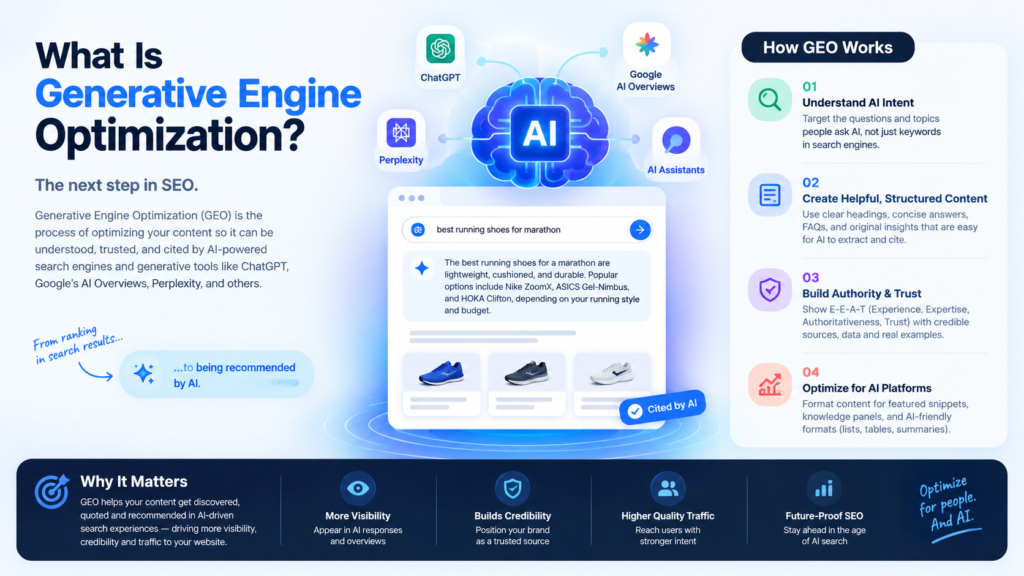
What Is Generative Engine Optimization?
Generative Engine Optimization (GEO) is the practice of structuring and tuning your content so generative AI models—like Google AI Overviews, ChatGPT, Claude, and Perplexity can easily understand, pull from, and cite your site as a direct source in their synthesized answers.
Traditional SEO gets users to click through to your website from a list of results. GEO ensures your brand is featured inside the answer the AI generates on the spot.
This concept isn’t just marketing hype—it’s grounded in hard research. A landmark study from researchers at Princeton University, Georgia Tech, and the Allen Institute for AI introduced GEO as an explicit framework. Their experiments showed that applying specific GEO strategies increased a website’s visibility in AI-generated answers by up to 40%.
How Generative AI Changes the Search Dynamic
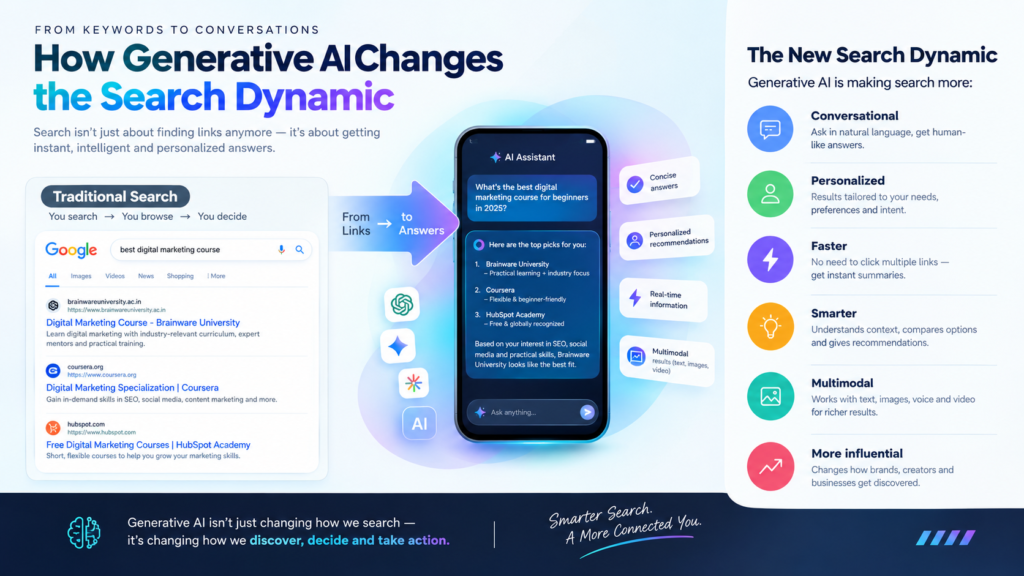
Traditional search engines index pages; AI engines synthesize information.
Instead of searching for a short phrase like “best SEO software” and opening four different tabs, a user today is much more likely to prompt an engine with context:
“I run a mid-sized e-commerce site. What are the best SEO tools for technical audits and keyword research under $150 a month, and how do their learning curves compare?”
Notice what’s happening here. The user isn’t looking for a list of links; they’re looking for a curated recommendation.
For your content to be pulled into that answer, simply dropping keywords into your H2 tags won’t cut it. The AI needs clear data points, direct comparisons, transparent pricing context, and authoritative opinions it can extract with high confidence.
GEO vs. SEO: Is Traditional SEO Dead?
In short: No. GEO isn’t replacing traditional SEO; it sits directly on top of it.
If search engines can’t crawl, index, or parse your site, generative AI systems won’t be able to retrieve your content either. The two strategies simply focus on different stages of how information is processed:
| Feature / Attribute | Traditional SEO | Generative Engine Optimization (GEO) |
| Primary Goal | Rank in classic search results (SERP positions 1–10) | Earn direct citations in AI-synthesized responses |
| Primary Target | Search engine crawlers (Googlebot) | Large Language Models (LLMs) & RAG retrieval pipelines |
| Query Style | Short or long-tail keywords (“best SEO tools”) | Conversational prompts (“Compare top SEO tools for a beginner on a budget”) |
| Optimization Focus | Keyword placement, page speed, backlink volume | Clear data points, direct definitions, structured tables, E-E-A-T |
| Success Metrics | SERP rankings, organic CTR, site visits | Brand citation frequency, referral traffic from AI engines |
Instead of choosing between SEO and GEO, think of it as SEO + GEO. Your foundational technical SEO gets you through the door, while your GEO tactics ensure the AI actually uses what you wrote.
5 Practical Ways to Optimize Content for AI Search
Optimizing for generative search doesn’t require secret technical tricks. It comes down to making your information clean, verified, and impossible to misunderstand.
1. Give Answers Upfront (The “BLUF” Approach)
AI engines value clarity above all else. Use the Bottom Line Up Front (BLUF) principle: if a section heading asks a question, answer it explicitly in the very first sentence.
- Don’t: Write three paragraphs of background history before explaining what a topic is.
- Do: Provide a clear, 2-sentence definition directly under the heading, then follow up with deeper context, bullet points, and real-world examples.
2. Back Up Claims with Hard Data and Sources
The Princeton study revealed a massive takeaway: adding statistics, data points, and clear source citations provided the highest boost in AI visibility (up to 40%).
When writing key arguments:
- Cite the original research paper, institution, or report.
- Include explicit numbers rather than vague claims (e.g., “increased conversions by 24%” instead of “significantly improved performance”).
- Contextualize what the data actually measures so the AI doesn’t misinterpret your point.
3. Structure Content for Easy Extraction
LLMs love clean formatting because it reduces parsing errors during the retrieval-augmented generation (RAG) process.
To make your content AI-friendly:
- Use descriptive H2 and H3 subheadings.
- Break dense walls of text into bulleted lists or numbered steps.
- Use comparison tables for features, pricing, or pros/cons.
- Add structured markup like Article and FAQPage Schema so crawlers can map your entities clearly.
4. Prove Real Experience (Show, Don’t Just Tell)
Generic AI summaries sound identical because they rehash the same web data. The easiest way to stand out—to both human readers and search algorithms—is by injecting first-hand experience.
Instead of writing a generic statement like “AI tools help speed up keyword research,” walk through your team’s exact workflow:
“When we run keyword research for new projects, we start by feeding raw customer support logs into an LLM to pull out recurring user questions. From there, we plug those topics into Ahrefs to cross-reference search volume, analyze search intent, and draft targeted content briefs.”
Including original screenshots, campaign data, personal experiments, and case studies gives your content unique value that AI cannot fabricate.
5. Build Content Clusters to Establish Authority
An isolated blog post rarely convinces an search engine that you’re a subject-matter expert. AI systems evaluate your entire site’s footprint to determine topical authority.
Organize your content into logical clusters with natural internal links. For example, a core guide on Generative Engine Optimization should interlink with sub-topics like:
- How Google AI Overviews Work
- Schema Markup for AI Search
- How to Conduct an AI Content Audit
- Prompt Engineering for Content Strategy
Pre-Publishing GEO Checklist
Before hitting publish on your next article, run through this quick checklist:
- [ ] Does the intro get straight to the point without unnecessary filler?
- [ ] Does every main heading offer a clear, direct answer in the first sentence?
- [ ] Are factual claims backed up by real statistics, dates, or expert quotes?
- [ ] Is the page broken up with bullet points, callout boxes, or comparison tables?
- [ ] Did you include a real case study, screenshot, or personal workflow?
- [ ] Are related articles on your site connected through contextual internal links?
- [ ] Is author information clearly visible on the page to support E-E-A-T?
Final Thoughts
Generative Engine Optimization isn’t about gaming an algorithm or chasing every temporary AI update. It’s about building content that is clean, authoritative, well-researched, and genuinely useful.
As search tools continue to evolve into conversational assistants, the sites that win won’t just be the ones ranking for individual keywords—they’ll be the trusted sources that AI engines rely on to answer complex questions accurately.

Leave a Reply